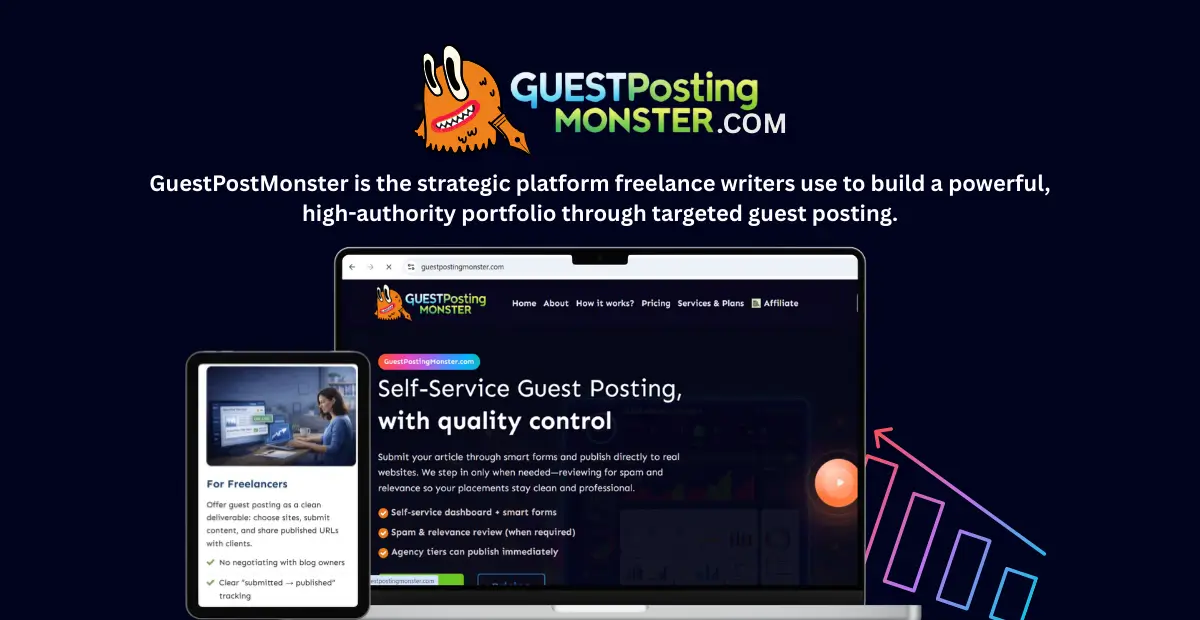

GuestPostingMonster makes the difficult search for good guest posting spots much easier and more strategic for any writer who wants to build a strong portfolio that will attract clients. It’s not enough to just find a place to publish; you also need to build a body of work that shows you’re an expert, gets you more attention, and moves your career from freelance writer to well-known industry voice.
How Freelance Writers Can Build a Powerful Portfolio by Mastering GuestPostingMonster
To be successful as a freelance writer, you need more than just talent. You also need a strategic platform to show off your skills and get high-authority bylines. This site isn’t just another place to buy and sell content; it’s a unique place for freelance writers to build a portfolio full of high-quality, diverse, and powerful work. GuestPostingMonster makes it easy for you to connect with authoritative sites, which lets you use guest posting as a deliberate career strategy. This turns single assignments into a cohesive story of professional growth and visibility.
The Modern Writer’s Problem: Skill, Exposure, and the Missing Link
The main problem is not usually a lack of skill but a serious lack of clear, believable evidence.
This is where regular job boards and content mills fall short. They offer deals, not career growth. Your portfolio is now full of ghostwritten pieces for unknown blogs or articles with no byline. These don’t help you build your authority or get better clients. Guest posting on well-known sites has always been the answer, but the process of finding the right sites, pitching cold, and following editorial guidelines takes time that could be better spent writing.
This is the story of the modern freelancer: skilled but not seen, able but not given credit. The platform understands that a writer’s portfolio is their most valuable asset. The platform meets the emotional and professional need for recognition by giving you a structured way to turn your writing from a product into a valuable asset.
This makes it clear that GuestPostingMonster is a network of writers with a purpose.
GuestPostingMonster is a curated network that connects writers with website owners and editors who are actively looking for high-quality guest content. It works on the ideas of quality and relevance, unlike public pitching platforms where noise drowns out signal. For a freelance writer, it’s not so much about getting one job as it is about finding a way to build their portfolio in a systematic way.
How the Platform Helps You Build Your Portfolio
A strong portfolio works for more than one person. It shows range (in terms of topics, industries, and tones), authority (the publishers’ credibility), and results (engagement, backlinks for the client, and thought leadership). GuestPostingMonster was made to hit these exact points. The sites on this list usually have excellent Domain Authority (DA) and many readers, so your byline is important.
There are many different topics, so a finance writer can write about fintech, or a lifestyle writer can write about trends in sustainable living on reputable sites. This turns your portfolio from a static PDF into a dynamic display of your digital footprint.
The platform also looks for opportunities. You can look for sites by niche, required DA, and even the kind of content they have (like long-form guides, opinion pieces, and listicles). This transforms the process of building a portfolio from a random hope into a focused mission. You don’t have to wonder if a site accepts contributors anymore; you know their requirements ahead of time, so you can tailor your pitch and sample exactly. This efficiency changes everything; it frees up the time you would have spent researching to spend on making great applications.
The Step-by-Step Workflow: From Sign-Up to Published Byline
Using the platform is a planned process. This is your first audition: you make a detailed writer profile. Point out your strengths, link to work you’ve already done, and explain your unique perspective. This isn’t a CV; it’s a professional value proposition.
Next, you look through the job openings that are available. Use filters wisely. If you want to get into the SaaS business, look for tech and business sites with a DA of 40 or higher. Do you know of a site that has in-depth case studies? That’s your sign to suggest a story-based look at a project you’ve worked on. The pitching stage is crucial. Look at the site’s most recent posts, suggest a new angle that would work for their audience, and include a writing sample that fits. Once accepted, you work directly with the site editor to make a piece that is excellent for both you and them, following their rules.
Making a Guest Posting Monster Strategy That Focuses on Your Portfolio
Getting guest posts is not enough. The professional writer thinks like a portfolio architect when they use GuestPostingMonster. You want to write a body of work that tells a powerful story about who you are as a professional.
Before you apply for any job, think about what your ideal portfolio will look like in six months. Do you want people to think you’re an expert in running a business that is beneficial for the environment? Then focus on a mix of business ethics magazines, high-DA environmental blogs, and innovation hubs. Use the platform’s filters to keep going after this group of niches.
An article can do more than one thing. First, it’s a headline. Second, you can turn it into a PDF for custom pitches (with permission). Third, you can turn the topic into a keynote speech or a lead magnet on your website. Fourth, having a positive relationship with the editor can lead to regular contributions. When you pitch, don’t just think about the one-time deal. In your author bio, don’t just link to your homepage; link to a specific service page on your relevant site. This makes a guest post a direct funnel.
As you publish more, curation becomes more important. Don’t just write down every article. Make sections on your website for your portfolio, such as “Featured In,” “Deep-Dive Analyses,” and “Industry Commentary.” For each piece, write a short context: “This piece for [Site Name] looked at the problem of X and led to a 20% increase in social shares for the publisher.” This demonstration demonstration shows that you know what impact is. GuestPostingMonster gives you the raw material; you put it together to tell a story.
The Hidden Traps: How Writers Sabotage Their Own Work
Even with a strong platform, mistakes can make your results less clear. Knowing about these common mistakes sets the tactical writer apart from the strategic portfolio builder.
The most common mistake is to think of GuestPostingMonster as a numbers game. Writers send out generic pitches to every high-DA site, getting a random mix of bylines on topics ranging from cat grooming to cryptocurrency. This technique screams “job seeker” instead of “expert” to an editor or client looking at your portfolio. The correction hurts, but it’s necessary: specialization. Decline offers that don’t fit with your main story, no matter how flattering they are.
You got the credit. You put the link to your portfolio in. Is the work done? No. This stage is where most writers stop, missing out on a lot of value. If you don’t promote your own guest post through your newsletter, social media, and LinkedIn, you’ll lose the extra visibility. Not taking care of the relationship with the editor makes sure that it stays a one-time thing.
The corrective action is planned: Always share the published piece widely, tag the publication and editor, respond to comments, and send the editor a personal thank-you email that hints at a future angle. Such behavior turns a business deal into a relationship, which is the real money for a long-lasting career.
On GuestPostingMonster, the writing sample you send with your pitch is often more important than the pitch itself. The mistake is thinking that editors will see your potential. They won’t. They make judgments based on what they see. Always include a sample that is similar in style, depth, and subject matter to the site you want to reach. Make a “spec” piece on your blog first if you don’t have one. It’s an investment that pays off in many ways.
From Byline to Business: Changes to Portfolios in the Real World
Case Study 1: The Change from Generalist to Authority. Maya was a good generalist writer. She wrote about travel, personal finance, and technology on a lot of low-DA blogs. Her portfolio seemed like a mess. She joined GuestPostingMonster with the goal of becoming a well-known voice in the fields of digital nomadism and remote work. She pitched data-driven articles on how to manage a remote team and very personal essays on how digital nomads can get burned out. In less than eight months, she had 12 bylines on well-known sites like Remote.co and Nomad List. She changed the design of her portfolio website to fit this group and called herself a “Remote Work Strategist & Writer.” What happened? GuestPostingMonster gave her the right chances, and her strategic focus made the story.
Case Study 2: David was an engineer who wrote long, technical case studies for businesses that worked with other businesses. He wanted to get into mainstream tech journalism to get more attention and charge more for his work. Editors in the media were unable to view his impressive portfolio. While using GuestPostingMonster, he only looked at tech news and analysis sites with a high domain authority (DA 60+). Instead of his usual long case studies, he used his knowledge to suggest “explainer” articles on difficult subjects like quantum computing or API security, writing them in a way that would appeal to a wide range of smart readers. He could make things easier to understand without making them less smart because he knew so much. His first byline in a major tech magazine became the best thing in his portfolio. He used that credibility to get two more guest posts on sites that were in competition with his own, which started a virtuous cycle.
The Future of Portfolio Building: AI, Authenticity, and Integration
The world of freelance writing is always changing, and so are the uses of sites like GuestPostingMonster. Writers who do well will use these tools in more and more advanced ways in the future.
Building a portfolio will be less about a static “clips” page and more about having a professional presence that is always changing and connected. You will need to include your GuestPostingMonster bylines in your LinkedIn featured section, your Twitter and Instagram bios, and even in interactive parts like video summaries of your articles. The platform may change to include writer analytics, which would show you which of your pieces brought the most visitors to the host site. This would give you a strong results-based metric to add to your portfolio.
Also, the rise of AI-generated content will make real human authenticity and proven expertise the most important things that set people apart. A portfolio made up of real guest posts for well-known human-edited sites will be the gold standard that sets serious writers apart from content factories. GuestPostingMonster will probably get more requests for writers who can write original thought leadership, interviews, and deeply reported stories—things that AI can’t do. So, your strategy should focus on pitching uniquely human ideas, like opinion pieces based on your own experiences, controversial takes on industry norms, or narrative stories with emotional arcs.
The smart writer today is getting ready for this by using platforms not just to get their work out there, but also to build a body of work that is clearly and permanently human.
Your Portfolio Is Your Legacy
A freelance writer’s career is like a mosaic, with each published byline being a tile. When put together with care, it becomes a work of art that shows who you are as a professional. GuestPostingMonster is more than just a way to pitch; it’s the carefully chosen gallery where you pick your tiles. It gives you the framework to go from wishing for chances to creating a clear, believable, and captivating story of your expertise. But the way is clearer. Don’t just put together a bunch of clips. Create a portfolio of proof that shows not only that you can write but also that you are qualified to be a part of the most important conversations for your career. Don’t ask for a byline right away. Instead, decide what story your portfolio will tell, and let each guest post be the next chapter in that story.