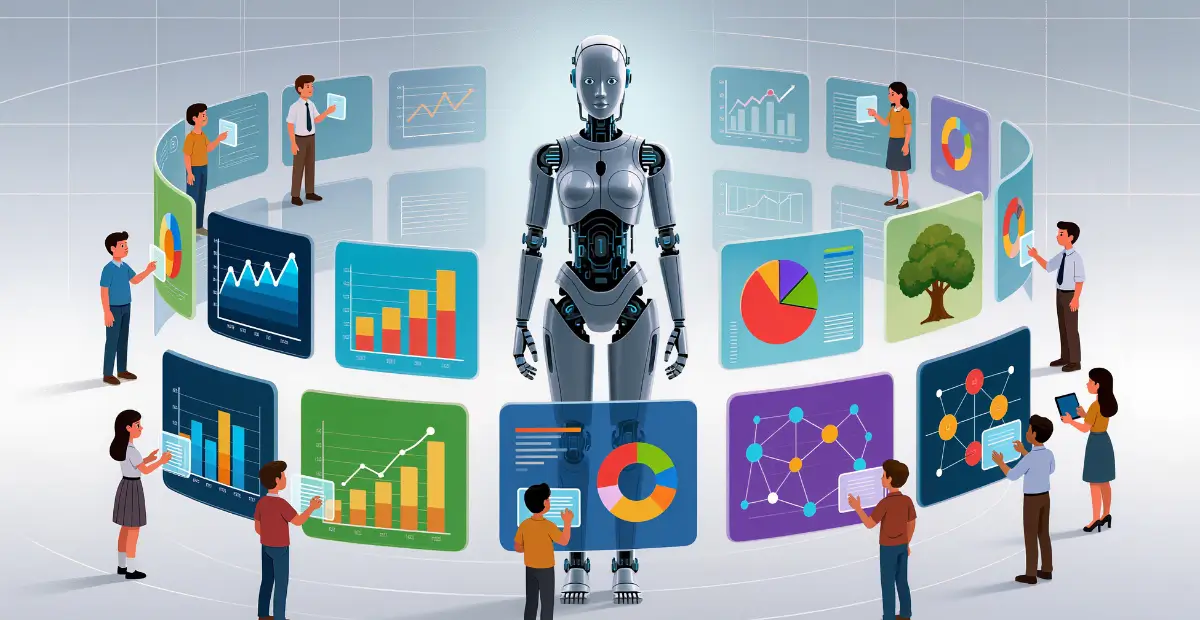
The conversation about **AI tools ChatGPT and Beyond** is rapidly evolving from speculative debate to daily reality. While the public’s imagination has been captured by chatbots that draft emails and essays, a deeper, more profound shift is occurring across every sector. This new wave of **applied AI tools** is not merely automating tasks; it’s augmenting human capability, creating entirely new roles, and fundamentally **changing the job market** for professions far removed from writing and content creation. The true transformation lies in specialized platforms that analyze data, design molecules, manage complex logistics, and even diagnose equipment failures, making AI proficiency the newest and most critical form of workplace literacy. ## The Real AI Disruption Isn’t What You Think We’ve all seen the headlines: “AI Will Take Your Job.” This narrative, often fueled by a narrow understanding of tools like ChatGPT, breeds anxiety but misses the broader, more nuanced picture. The real story isn’t about replacement; it’s about radical augmentation and the birth of hybrid roles. Consider a radiologist. The threat isn’t an AI that writes reports, but an **applied AI tool** like Aidoc or Zebra Medical Vision that analyzes thousands of medical images in seconds, highlighting anomalies for the radiologist to review. The job transforms from “finder” to “confirmer and consulter,” requiring new skills in AI interface interaction and data interpretation. This shift carries deep human significance. It’s about democratizing expertise and elevating judgment. A junior graphic designer can now use Midjourney or Adobe Firefly to rapidly prototype concepts, compressing weeks of iteration into hours. A small-scale farmer in Kenya can use an AI-powered satellite imagery tool to assess crop health, a level of analysis once available only to agribusiness giants. The emotional core of this transition is the liberation from repetitive, mechanistic work, allowing professionals across fields to focus on strategy, creativity, empathy, and complex problem-solving—the inherently human skills that machines cannot replicate. ## Beyond the Chatbot: A Taxonomy of Applied AI in the Workplace To move beyond the hype, we must categorize the **AI tools** creating tangible impact. This isn’t about a single technology, but a suite of capabilities solving specific, high-value problems. ### The Analytical Engines: AI for Data, Design, and Discovery This category includes tools that process vast, complex datasets to find patterns, optimize systems, and accelerate innovation. They are the silent workhorses powering decisions in labs, boardrooms, and factories. * **Scenario in Scientific Research:** A pharmaceutical researcher isn’t using ChatGPT to cure cancer. Instead, they’re leveraging platforms like **Atomwise** or **Insilico Medicine**. These tools use AI for **virtual screening**, simulating how millions of molecular compounds might interact with a disease target. What once took years and millions of dollars in physical lab tests can now be narrowed down to a few promising candidates in weeks. The researcher’s role evolves from manual trial-and-error to designing better simulation parameters and interpreting AI-generated proposals within a biological context.* **Framework for Operational Efficiency:** In sectors like logistics, manufacturing, and energy, **predictive maintenance AI** is a game-changer. Here’s how it works in practice: 1. **Sensor Integration:** IoT sensors are placed on critical equipment (e.g., wind turbines, assembly line robots). 2. **Data Aggregation:** The AI tool (like those from C3.ai or Uptake) ingests real-time data on vibration, temperature, sound, and performance metrics. 3. **Pattern Recognition:** The algorithm compares incoming data against historical models of both normal operation and pre-failure states. 4. **Proactive Alerting:** Instead of a mechanic scheduling routine maintenance or reacting to a catastrophic failure, they receive an alert: “High probability of bearing failure in Unit 7 within the next 96 hours.” 5. **Action:** Maintenance is scheduled precisely when needed, minimizing downtime and saving costs. The mechanic’s skill set now includes interfacing with AI diagnostics and executing complex repairs. ### The Creative and Strategic Co-Pilots These **applied AI tools** assist in conceptualization, design, and strategic planning, acting as force multipliers for human creativity. * **In Architectural Design:** Tools like **TestFit** or **Spacemaker** (now part of Autodesk) allow architects and urban planners to input site constraints, zoning laws, sunlight directives, and cost parameters. The AI generates dozens of viable building massing and layout options in minutes. The architect’s genius is no longer spent manually sketching every permutation, but in selecting and refining the most promising AI-generated concepts, applying aesthetic and human-centric design principles the AI cannot grasp.* **In Legal and Compliance:** Platforms like **Harvey.ai** or **Kira Systems** are transforming legal practice. They can review thousands of contracts during due diligence, flagging non-standard clauses, potential liabilities, and compliance issues against a defined playbook. The lawyer’s value shifts from the exhausting “find the needle in the haystack” review to negotiating the specific high-risk issues the AI has surfaced, focusing on strategic counsel and client relationship management. ## Building Your AI-Augmented Career: A Strategic Framework Adapting to this new landscape requires proactive strategy, not passive worry. Here’s an expert-level framework for any professional to future-proof their career. 1. **Audit Your Workflow for Augmentation Points.** Don’t ask, “Will AI do my job?” Ask, “Which parts of my job are data-rich, pattern-based, or repetitive?” List your weekly tasks. For a marketing manager, this could be social media performance reports, A/B test analysis, or initial audience segmentation. These are prime candidates for AI augmentation.2. **Develop “AI Translator” Skills.** The most valuable employee in the next decade will be the one who can bridge the gap between domain expertise and AI capability. This means learning to: * **Frame Problems for AI:** Can you precisely define a business problem (e.g., “reduce customer churn”) into a data question an AI can help solve (e.g., “identify the 5 key behavioral indicators that predict churn within 30 days”)? * **Curate and Critique Outputs:** AI tools can be confidently wrong. You must build the expertise to judge their suggestions. A financial analyst using an AI for market forecasting must understand the model’s biases and limitations to interpret its predictions correctly.3. **Master Prompt Engineering for Specialized Tools.** Beyond ChatGPT, every specialized tool has its own “language.” Invest time in learning the specific inputs, parameters, and data formats that yield the best results from the **AI tools** in your field. This is the new technical skill.4. **Double Down on Irreplaceably Human Skills.** Strategically invest in what AI lacks: complex negotiation, cross-disciplinary synthesis, ethical reasoning, mentoring, and narrative-driven leadership. Your competitive edge is your humanity. ## Common Pitfalls in Adopting Workplace AI (And How to Avoid Them) **Mistake 1: The “Set and Forget” Fallacy.** Deploying an AI tool without human oversight. *Why it Hurts:* AI models can drift, and real-world contexts change. An AI optimizing a supply chain for cost in 2023 might fail to adapt to a new geopolitical priority like supplier resilience in 2024.* **Correction:** Establish a human-in-the-loop (HITL) review protocol. Designate a team member to regularly audit AI decisions, validate outputs against real-world outcomes, and retrain or adjust models as needed. **Mistake 2: Ignoring the Data Foundation.** Expecting magical results from a tool fed poor-quality, biased, or insufficient data. *Why it Hurts:* “Garbage in, garbage out” is the cardinal rule of computing, and it’s doubly true for AI. A recruiting AI trained on historical hiring data may simply automate past biases.* **Correction:** Before implementing any AI, invest in data hygiene. Clean your datasets, audit them for bias, and ensure you have a robust pipeline of relevant, high-quality data. The tool is only as good as the fuel you give it. **Mistake 3: Treating AI as a Cost-Center, Not a Capability-Builder.** Leadership viewing AI purely as a way to reduce headcount. *Why it Hurts:* This mindset destroys morale, encourages poor implementation, and misses the true value: empowering your team to achieve more and tackle bigger problems.* **Correction:** Frame AI adoption as “augmentation, not automation.” Measure success not just in efficiency gains, but in new products developed, improved customer satisfaction scores, or enhanced employee skill levels. ## Applied AI in Action: Real-World Transformations **Case Study 1: Siemens and Generative Design in Engineering.** Siemens uses **generative design AI** (within their NX software) to create components for manufacturing. Engineers input design goals, materials, and constraints (e.g., must withstand X force, use Y material, weigh less than Z). The AI then explores all possible permutations of a solution, often producing organic, lattice-like structures no human would intuitively design. One result? A bracket for an aerospace application that was **35% lighter** while maintaining all strength requirements. The engineer’s role was to define the problem and constraints, then select and validate the most manufacturable and elegant of the AI’s proposals. **Case Study 2: John Deere and Precision Agriculture.** The modern John Deere tractor is a rolling data center. Its AI-powered systems, like **See & Spray**, use computer vision to distinguish between crops and weeds in real-time. As the tractor moves through a field, it sprays herbicide only on the weeds, reducing chemical use by up to **77%** compared to blanket spraying. The farmer is elevated from driver to fleet and data manager, analyzing AI-generated field health maps to make strategic decisions about planting, irrigation, and harvest. **Case Study 3: WongDoody (Creative Agency) and Creative Scale.** The advertising agency WongDoody developed an internal AI tool, **“Liz,”** to handle the repetitive, time-consuming aspects of creative production. For a client needing hundreds of personalized banner ads, Liz could automatically generate copy variations, resize images, and adhere to brand guidelines across dozens of formats. This freed the human creative team to focus on the high-concept campaign idea, the emotional storytelling, and the big-picture strategy that the AI could never conceive. ## The Next Frontier: Autonomous Agents and the Evolving Human-AI Partnership Looking ahead, the standalone **AI tools** of today will evolve into interconnected **autonomous agents**. Imagine not just a tool that designs a part, but an agent that designs it, simulates its performance, sources manufacturers, negotiates pricing, and manages its quality assurance—all while keeping the human engineer informed at key decision points. The workplace will see the rise of **AI Managers**—humans who oversee teams of these specialized agents, providing strategic direction, ethical guardrails, and final approval. The demand for cross-disciplinary thinkers will skyrocket; a biologist with computational skills or a philosopher who understands algorithmic bias will be invaluable. Furthermore, as AI handles more execution, the premium on **soft skills**—fostering trust, navigating organizational politics, driving cultural change—will become the ultimate career differentiator. ## Embracing Your Augmented Future The seismic shift driven by **ChatGPT and beyond** is an invitation to elevate our work, not an end to it. The **job market** is not shrinking; it is morphing, demanding a new synergy between human intuition and machine intelligence. The professionals who will thrive are those who approach **applied AI tools** not with fear, but with strategic curiosity. They will be the architects of new processes, the translators between human need and machine capability, and the ethical stewards of this powerful technology. Your task is not to compete with the machine, but to master the art of partnering with it, leveraging its boundless capacity for analysis to amplify your uniquely human capacity for wisdom, creativity, and connection. The future belongs to the augmented.
ChatGPT and Beyond: The AI Tools Reshaping Every Career Path