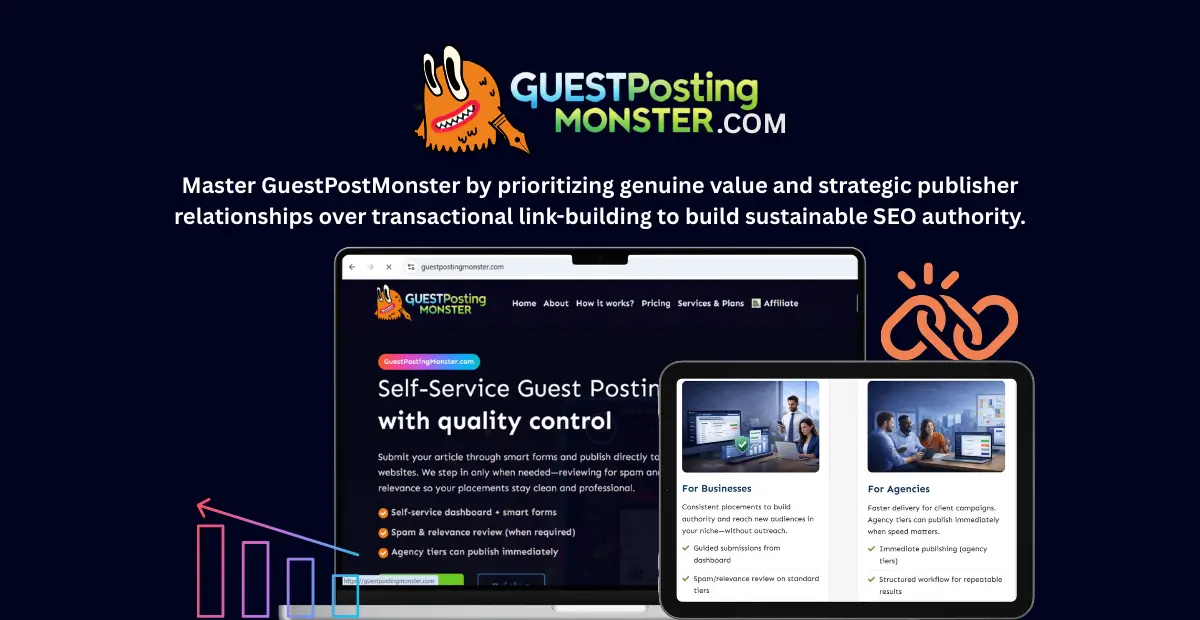

GuestPostingMonster is a fantastic way to get authoritative backlinks, but to really succeed, you need to stop thinking of it as just a marketplace. This complete guide gives a senior strategist a plan for how to master the platform. This guide will transform your approach from merely setting up a basic account to creating a strategic, high-return campaign focused on acquiring genuine links and fostering real relationships with publishers.
Everything You Need to Know to Succeed on GuestPostingMonster: Setting up your account and getting backlinks
If you don’t treat GuestPostingMonster like a simple marketplace, it can feel like you’re opening a secret door to real publisher relationships and authoritative backlinks. This full guide cuts through the noise and gives you a senior strategist’s plan for turning your account setup into a systematic, high-return campaign. We’ll go over the complicated art of profiling, the science of publisher vetting, and the subtle craft of the pitch that works, making sure that every step you take on the platform leads to long-term SEO growth and real digital authority. This guide provides a systematic approach to achieving success on GuestPostingMonster.
Opening Insight: Why GuestPostingMonster Isn’t a Magic Bullet (And That’s a Good Thing)
Let’s be completely honest for a second. In the realm of SEO, the allure of effortless backlinks has lured numerous strategists into the pitfalls of spammy directories, ineffective PBNs, and penalized sites. This is the point at which GuestPostingMonster becomes indispensable. It’s not a magical creature that grants wishes; it’s a real platform that connects real writers with real publishers. I started my journey with it because I was so tired of the endless cold outreach, broken promises, and unclear prices in the “gray market” for guest posting. I needed to be efficient, but I wouldn’t give up on quality.
What I found was a tool that, once you learn how to use it, turns a messy, relationship-heavy process into a smooth, scalable plan. The emotional connection here isn’t to the platform itself, but to the freedom it gives you: the freedom to focus on making outstanding content and getting real visibility instead of getting lost in the logistical nightmare of finding a place for it. To do well on GuestPostingMonster, you need to know that it works like the real-world editorial process, but with clear signs on the doors and all the gatekeepers in one room.
Clear Explanations of the Main Ideas: The Parts of a High-Value Guest Post
You need to understand what makes a guest post transaction valuable for everyone involved before you even make an account. This site isn’t a place where people trade money for links. You (the author/seeker), the publisher, and their audience all have something to gain from this.
The Publisher’s Mindset: What They Really Want
GuestPostingMonster publishers don’t just sit back and sell links. They are active editors and site owners who want one thing above all else: content that is useful to their readers. They look at pitches from two angles: “Will this source of information keep my audience interested, informed, or entertained?” and, “Does this source (you) make my site more credible?” They will give you a link to your site in exchange for the free, high-quality content you give them that makes their editorial work easier. When you think of your approach this way—as a contributor helping them solve their problem—you immediately stand out from 90% of seekers who are just sending out generic pitches.
The Seekers’ Framework: Outside of the DA Check
Domain Authority (or similar metrics, such as Domain Rating) is a useful tool for narrowing down your options on the platform; however, experienced strategists delve deeper. There are five factors that make up a true high-value placement:
- 1. Relevance: Does the main topic of the site fit perfectly with your niche? A link from a top-notch parenting blog doesn’t mean anything to a B2B SaaS company.
- 2. Audience Engagement: Check out the comments, shares on social media, and the quality of the content that is already there. An unchanging, high-DA site is less valuable than an active audience.
- 3. Editorial Standards: Are the posts well-written, well-organized, and checked for accuracy? This indicator shows that you care, and Google rewards that.
- 4. Link Profile: You can use a tool like Ahrefs or Semrush to quickly check if the site links to other trustworthy sites or if it is just a link farm in disguise.
- 5. Placement Potential: Can you naturally fit your link into educational or value-driven content, or will it just be put in a bio box? The first one always wins.
The Strategic Blueprint: From Setting Up an Account to Posting a Link
This phase is where we go from theory to action. Follow this framework exactly.
Step 1: Set up your basic account and profile
Don’t hurry this. Your GuestPostingMonster profile acts like a digital sales rep.
- Professional Bio: Write a third-person bio that shows off your knowledge and skills, not just your job title. “John helps cybersecurity startups explain complicated threats to buyers who aren’t tech-savvy” is better than “John is a content marketer.”
- Curate your portfolio by linking to three to five of your best published guest posts. If you don’t have any, showcase your abilities by creating two outstanding examples on your own website or on Medium.
- Niche Specification: Be clear about the topics you like. Digital marketing is too broad. You can aim for topics such as “SEO for Local Service Businesses” or “Content Strategy for Fintech Apps.”
Step 2: The Systematic Publisher Vetting Process
1. Use advanced filters Well, start with niche relevance and a reasonable DA/DR floor (like DR 30+), but then don’t pay attention to the metric as you look at it.
2. Do the “5-Minute Site Audit”: Go to the site. Check out a new post. Look at the “About” and “Contact” pages. Check the tone and the audience. Is there advertising on the screen? This indication shows that they are serious about making money and probably value traffic, so your content should help with that.
3. Figure out what the rules mean: Publishers often provide clear “writing rules.” These are a present. Breaking them is the quickest way to be turned down. Be sure to follow the rules for word count, formatting, links, and topics that are not allowed.
Step 3: The Pitch That Works
The pitch window is small. This is how to do it:
- Subject Line: Talk about a recent post you liked on their site and how it relates to your point of view. “I loved your article on moving to GA4. I have a deep dive on tracking on the server side for Shopify stores.”
- Hook at the beginning: Show right away that you know your audience. “For your readers who are growing their DTC brands, the data layer gaps in standard GA4 setups are becoming a big problem…”
- Suggested Angle and Main Points: Give 1–2 clear titles or points of view, and then list 3–4 specific, actionable things that the reader will learn.
- Why You Should Write It: Quickly connect your skills (from your profile) to the subject.
- Clear Call to Action: “I have this written and can change it to fit your rules.” Would this work with your editorial calendar?
Step 4: Write and send in your content
If you get the green light, go above and beyond.
• Stick to the Rules Exactly: Word count, formatting, and image requirements.
• Don’t write for your ego; write for your audience: Use the voice of the publisher. When appropriate, link to their internal resources. This shows that you care about their site.
• Putting links in a natural way: Your main link should be in the body of the text, where it can support a claim or add to a resource. The link to the author’s bio is your second bonus.
Step 5: Managing Relationships After Publication
This is the point at which the best strategists stand out.
- Promote the Post: Share it with excitement on all of your social media accounts, tag the publisher, and respond to comments. This shows that you are a partner and not just a link buyer.
- Add to Your Portfolio: Use the live link to quickly update your GuestPostingMonster profile and personal portfolio.
- Keep the Connection: Sending the editor a short thank-you email after the article is published can lead to future collaborations that don’t involve a platform.
The Costly Mistakes: Common GuestPostingMonster Errors and How to Fix Them
• Mistake 1: The “Spray and Pray” Pitch. Sending the same generic pitch to 50 different publishers. Why it hurts: Editors talk. If you send spam, you’ll be banned from the site. Correction: Change the first line of each pitch. It only takes 60 seconds and increases your acceptance rate by three times.
• Mistake 2: Putting metrics ahead of relevance. Going after a DR 80 site in a niche that has nothing to do with it. Why it hurts: Google’s algorithms are getting better at figuring out who is an expert on a subject. A link that isn’t relevant doesn’t help with SEO at all and looks like it’s trying to trick people. Correction: Use relevance as your main filter. A DR 40 site that is exactly in your niche is much more powerful than a DR 80 general news site.
• Mistake 3: Not paying attention to the publisher’s on-page experience. Sending in a wall of text without any headings, pictures, or data. Why it hurts: You’re making the editor’s job harder. Your goal is to make their work easier. If your content isn’t formatted correctly, it will be turned down or cause problems with other people. Correction: Send in content that is ready to be published. Use H2 and H3 tags, get high-quality images with the right credit, and make sure the text is easy to read.
• Error 4: Vanishing After Publication. You get the link and never talk to the publisher or the post again. Why it hurts: It ends a relationship. That publisher probably won’t take you back, and you won’t get the extra traffic and brand-building benefits that come with promotion. Correction: Follow the steps for the post-publication relationship that are listed above. Be a partner who stands out and is professional.
Real-World Uses: Two Detailed Campaign Scenarios
- Case Study 1: The Launch of B2B SaaS
A project management SaaS tool was adding a new AI feature. The goal was to encourage people to sign up and become experts on “AI in project management.”
• GuestPostingMonster’s strategy: They didn’t pay attention to general tech sites. Instead, they went after small publishers in the construction, marketing, and software development fields—areas where managing projects is crucial.
• Pitch and Content: Pitches focused on problems that are common in a certain industry, like “How Construction Foremen Can Use AI to Predict Project Delays.” It was very educational, and the links in the content led to their detailed feature comparison page (a middle-of-funnel resource), not the homepage.
• Result: Got 12 guest posts in three months. The links came from sites with a low DR (35–50), but they were very relevant. This campaign, along with their PR work, helped the new feature page rank on page one for a few mid-volume keywords in just five months. It also had a direct effect on enterprise trial sign-ups by bringing in referral traffic. - Case Study 2: The Authority on Building an E-commerce Brand
A brand that sells high-end kitchen knives directly to customers had a lot of competition for keywords like “best chef’s knife.”
• Plan for GuestPostingMonster: They changed their content from being about products to being about expertise. The goal was to be known as an expert on knife skills, kitchen craftsmanship, and the history of cooking.
• Pitch and Content: They looked for foodie blogs, culinary school resources, and sites for hobbyist chefs. They suggested topics like “The Anatomy of a Knife: A Guide to Bolsters, Tangs, and Grinds” and “How to Care for Carbon Steel: A Guide for the Home Cook.” Links to their detailed, non-commercial blog posts, “Ultimate Knife Care Guide” and “Steel Types Explained,” were added to the content in a way that made sense.
• Outcome: These links didn’t directly target commercial keywords, but they did help build a strong, relevant backlink profile. This wider authority boost raised the rankings of the whole site, even the pages for their commercial products. More importantly, the referral traffic from these posts had a very high time-on-site and conversion rate because the audience was well cared for.
The Future of Guest Posting and the Growth of Platforms
It’s clear that the trend is to use automation to find things and more human judgment to carry them out. Platforms like GuestPostingMonster will keep getting better. They will probably add more advanced vetting tools (like audience demographic data) and make it easier to communicate. But the standard for editors will only get higher. Because Google cares so much about E-E-A-T (Experience, Expertise, Authoritativeness, Trustworthiness), publishers will be even more picky. Not generalist writers, but specialist contributors will shape the future.
What this means for you is your GuestPostingMonster profile will need to work more and more like a credibility dashboard. You should be ready to prove your skills, maybe by linking to your social media profiles, showing off your formal certifications, or showing off work you’ve done for well-known brands. The pitch will be less about the idea itself and more about the unique point of view and proof of experience you bring to it. Also, the smartest SEOs will use these sites for more than just links; they’ll use them to build their brand and reach their audience directly, treating each guest post as a way to get into a new, active community.
The Unchanging Truth About Strategic Guest Posting
Mastering The main point of GuestPostingMonster is to stop thinking in terms of shortcuts. It indicates that the “hard way”—making real connections, providing value that can’t be denied, and trading good content for a contextual link—is the only way that will last. The platform doesn’t make you successful; it shows you how to do things. Here, a harmful, spammy method won’t work well.
A strategic, quality-focused approach will work great on a large scale. Your dashboard shows how professional you are. So, don’t think of each pitch as a deal; think of it as the beginning of a possible partnership. In the end, the most valuable thing you get might not be the backlink in your SEO report, but the relationship you build with an editor who asks you to write for them again, this time not on the platform. That is the real sign that you have beaten the beast.