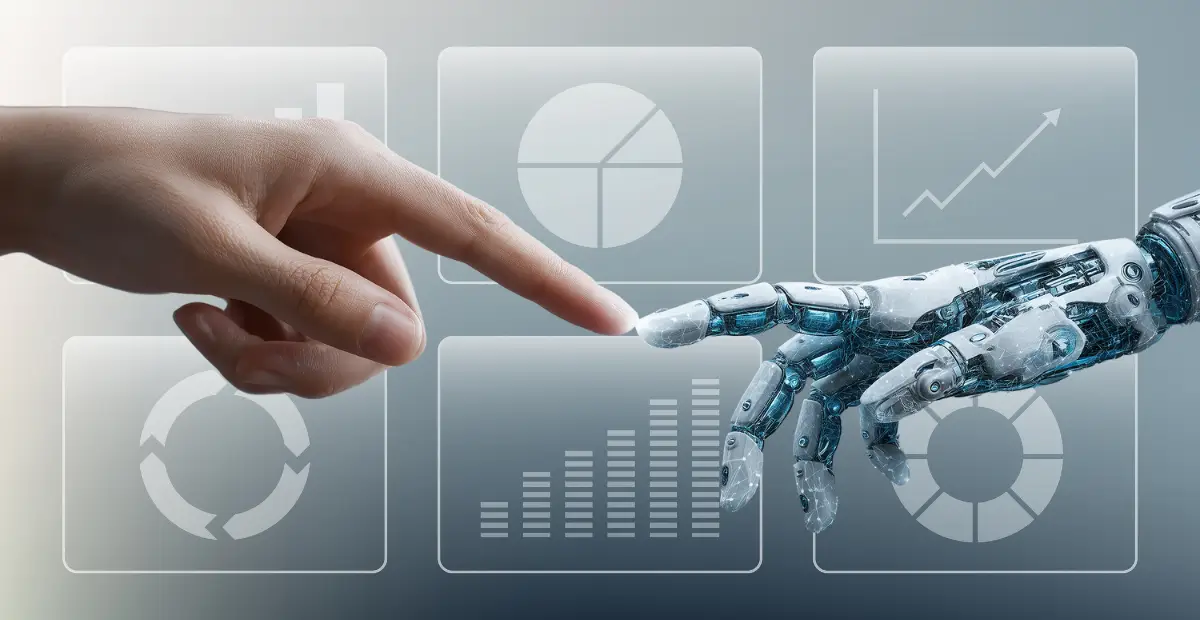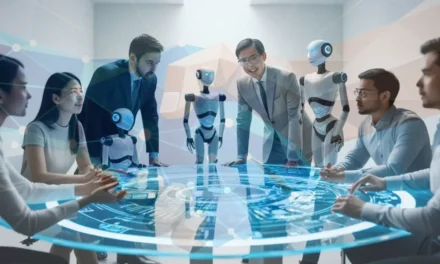
AI's workforce impact is here. For creative and managerial roles, it's not a simple replacement but a powerful collaborator. Success requires strategically blending technological fluency with uniquely human strengths like judgment, emotional intelligence, and creativity.## Opening Insight: The Anxiety and the OpportunityThe chatter in industry newsletters and on LinkedIn is a mix of excitement and dread. A marketing director uses an AI tool to draft a campaign brief in minutes, then wonders if her strategic thinking is next. A novelist leverages language models to overcome writer’s block, while quietly fearing for the soul of his craft. This tension defines our moment. The anxiety is real and valid, rooted in historical waves of technological unemployment. Yet, this wave feels different because it’s targeting cognitive work—the domain we once considered uniquely and securely human.AI automates the mind, not just muscle. It masters scale and patterns, while humans provide context, ethics, and meaning. The true risk is job evolution, not elimination. Success belongs to those who use AI as a strategic co-pilot—amplifying output and insight—rather than a mere tool. Ultimately, this is about reinventing professional identity around the human mission, not just the tasks. ## Core Concepts Explained Clearly To move past hype and fear, we must ground the discussion in what AI actually is and isn’t capable of in professional contexts. This isn’t about sentient robots; it’s about sophisticated software tools with specific, powerful applications. **Generative AI vs. Analytical AI:** Most of the current buzz surrounds *generative* AI—tools like ChatGPT, DALL-E, and Midjourney that create new text, images, or code. They are probabilistic, predicting the next likely word or pixel based on massive training data. Their output is often impressive but can be generic, unmoored from true understanding, and prone to "hallucinations." *Analytical* AI, on the other hand, includes machine learning models that parse data, predict trends, and optimize processes. For managers, this might mean a tool that forecasts Q4 sales; for a creative, it might mean an analytics platform that identifies which content themes resonate most. **Augmentation vs. Automation:** This is the critical distinction for professional roles.- **Automation** is about complete replacement of a task or role. AI can automate the generation of routine reports, basic social media posts, or standard legal documents.- **Augmentation** is about partnership. Here, AI handles the heavy lifting of data processing, ideation, or first drafts, freeing the human professional to focus on higher-order thinking: refining strategy, injecting brand voice, making ethical calls, and building client relationships. For creative and managerial jobs, the immediate future is one of predominant augmentation, with automation chipping away at the most routine, repetitive tasks within those roles. ### H3 — 2.1: The Creative Professions Under the Microscope The initial shock of AI writing poetry or winning art contests has given way to a more pragmatic landscape. AI is becoming a staple in the creative toolkit, but its role is that of an assistant, not an auteur. Consider a graphic designer. AI image generators can produce hundreds of concepts in an hour based on a text prompt. This doesn’t eliminate the designer; it transforms their workflow. The designer’s skill shifts from manually manipulating pixels in early ideation to becoming a "creative director" for the AI: crafting exquisite prompts, curating the best outputs, and then applying critical human judgment. Does this image align with the brand’s emotional narrative? Is it culturally appropriate? Does it have the subtle imperfection that makes it feel authentic? The designer then uses their technical skills to refine, composite, and perfect the AI-generated asset. The value moves *upstream* to strategy, art direction, and taste, and *downstream* to final polish and client-specific customization. ### H3 — 2.2: The Managerial Hierarchy Reimagined Management has always been about planning, organizing, leading, and controlling. AI is poised to revolutionize each of these pillars, not by replacing the manager, but by making them exponentially more informed and effective. Think of a middle manager responsible for a team of twelve. AI tools can now automate the generation of performance reports (controlling), schedule optimal meetings (organizing), and even draft initial project plans (planning). The manager’s liberated time can be invested in the "leading" component: high-quality, one-on-one coaching, mediating complex interpersonal conflicts, and fostering team innovation. Their decision-making is supercharged by AI-driven predictive analytics. Instead of relying on gut feel for a hiring decision, they can be alerted to patterns in candidate assessments. Instead of a quarterly business review based on last month’s data, they can have a real-time dashboard predicting operational bottlenecks. The managerial role becomes less about administrative oversight and more about human development and strategic course-correction—skills far beyond AI’s reach. ## Strategies, Frameworks, or Actionable Steps: The Human-AI Hybrid Professional Surviving and thriving in this new environment requires intentional upskilling and a shift in mindset. Here is a practical framework for any creative or managerial professional. **1. Adopt a "Centaur" Mindset:** In chess, a "centaur" is a human-AI team that consistently beats both grandmasters and supercomputers alone. Apply this to your work. Break down your key projects into tasks. Identify which tasks are **AI-Dominant** (data crunching, transcription, broad ideation), **Human-Dominant** (final ethical approval, client persuasion, visionary strategy), and **Collaborative** (editing an AI draft, using AI analytics to inform a human decision). Your new job is to orchestrate this partnership. **2. Master Prompt Engineering and Critical Evaluation:** For creatives, this is your new foundational skill. Learn to write prompts that are specific, contextual, and iterative. "A logo for a tech company" is weak. "A minimalist, friendly logo mark for a sustainable fintech startup targeting millennials, evoking growth and security, using a palette of forest green and sky blue, in the style of contemporary Scandinavian design" is professional prompting. Equally crucial is developing a ruthless eye for evaluating AI output. You must spot clichés, factual inaccuracies, tonal mismatches, and logical gaps. **3. Double Down on Uniquely Human Capabilities:** Systematically develop the skills AI lacks. This is your defensible territory.- **Creative:** Develop your unique voice, narrative perspective, and ability to connect disparate ideas in novel ways (conceptual blending). Hone your skill in visual storytelling and emotional resonance.- **Managerial:** Invest in advanced coaching techniques, conflict resolution, stakeholder management, and fostering psychological safety. Build your capacity for nuanced ethical judgment in ambiguous situations. **4. Integrate AI into Your Personal Workflow Transparently:** Don’t hide your AI use; frame it as leveraging cutting-edge tools for greater efficiency and insight. For managers, this means auditing team workflows for augmentation opportunities and leading upskilling initiatives. For creatives, it means setting clear boundaries with clients on how AI is used in the creative process, maintaining integrity and trust. ## Common Mistakes and How to Avoid Them **Mistake 1: Treating AI Output as Final Product.** The most dangerous error is to copy-paste AI-generated text, strategy, or design without profound human intervention. This results in generic, often flawed work that damages your professional reputation and SEO (in the case of thin, duplicated content). **The Fix:** Establish a mandatory "human imprint" stage. Rewrite the first and last paragraphs of any AI text. Add personal anecdotes, bespoke data, and original insights. For designs, always customize and layer in unique elements. **Mistake 2: Ignoring the Data Pipeline.** AI’s analytical power is garbage-in, garbage-out. Managers using AI for decisions based on biased or poor-quality data will automate bad judgment. **The Fix:** Before deploying any analytical AI, audit your data sources for accuracy, completeness, and fairness. Implement human oversight checks on AI-driven recommendations, especially for personnel or significant financial decisions. **Mistake 3: Chasing Novelty Over Problem-Solving.** Professionals often get distracted by the latest AI tool without tying it to a core business or creative problem. **The Fix:** Start with the problem, not the tool. Ask: "What is the biggest bottleneck in my workflow?" or "What task consumes my time but adds the least unique value?" Then seek an AI solution specifically for that. **Mistake 4: Negating Your Own Creative Voice.** Creatives, in an effort to be efficient, can over-rely on AI for ideation, resulting in work that converges toward the algorithmic mean and loses their distinctive style. **The Fix:** Use AI for divergent thinking (generate 50 ideas), but use your human judgment for convergent thinking (select and develop the 2 best). Constantly ask, "How can I bend this output to reflect *my* perspective?" ## Case Studies, Examples, or Real Applications **Case Study 1: The Marketing Agency (Creative & Managerial Blend)**Result of Human-AI Partnership in a Digital Agency: By integrating AI for initial drafts and analytics, junior writers focused on high-value research and refinement, while strategists optimized performance. This augmented workflow boosted content output by 70%, improved engagement, and evolved roles from production grind to strategic creation.**Case Study 2: The Product Design Team at a Large Corporation**A consumer electronics company’s design team used to spend weeks on initial concept sketches for a new product line. They introduced an AI image generator into their brainstorming phase. In a single workshop, guided by senior designers’ prompts, they generated over 500 concept visualizations exploring form factors, materials, and colors. This exploded their creative possibilities. The designers then curated, debated, and blended the most promising AI-generated elements, using them as springboards for original, human-led designs. The process shortened the concept phase by 60% and led to more innovative final products, as the AI helped break the team out of iterative ruts. The designers’ expertise was amplified, not replaced. **Case Study 3: The Senior Operations Manager**Result of Human-AI Partnership in Retail: An operations manager shifted from spending 10 hours on manual reporting to 1 hour reviewing AI-generated analysis. She now dedicates her time to visiting stores, coaching managers, and developing new training initiatives. This transition elevates her value from a routine executor to a strategic innovator.## Advanced Insights or Future Predictions Next Wave: Vertical AI. The future will move beyond general chatbots to specialized models trained on specific industries (law, medicine, engineering). These tools will deeply understand your field's jargon, regulations, and workflows, becoming far more powerful and seamlessly integrated into professional work.We will also see the rise of **AI-Native Processes.** It won't be "how do I add AI to my existing workflow?" but "if AI existed from the start, what would this workflow look like?" This will lead to radical restructuring of creative studios and corporate departments. We may see the emergence of the "AI Whisperer" or "Human-AI Integration Lead" as a core senior role. The most significant battleground will be **trust and authenticity.** As AI-generated content floods the market, the premium on verifiably human-created work will soar. Technologies like blockchain for provenance or "human authentication" badges may become standard. The ability to demonstrate the human story, the ethical considerations, and the personal touch behind a strategy or creative product will become a key differentiator. Professionals must also prepare for continuous, rapid upskilling. The AI tools you master this year may be obsolete in 18 months. The core meta-skill will be **adaptive learning**—the ability to quickly understand and harness new technological capabilities. ## Final Takeaway AI is reshaping jobs, not eliminating them. It shifts focus from routine tasks toward human skills like judgment, creativity, and connection. Success will favor those who solve problems and create value, not those who merely perform predefined tasks.Lead the human-AI partnership. Leverage uniquely human strengths—empathy, ethics, vision—and use AI to handle routine tasks and enhance your work. This shift is an opportunity to focus on what makes us human. The future belongs to those who skillfully integrate both worlds.
Is Your Job at Risk? A Realistic Analysis of the Impact of Artificial Intelligence on Creative and Managerial Professions