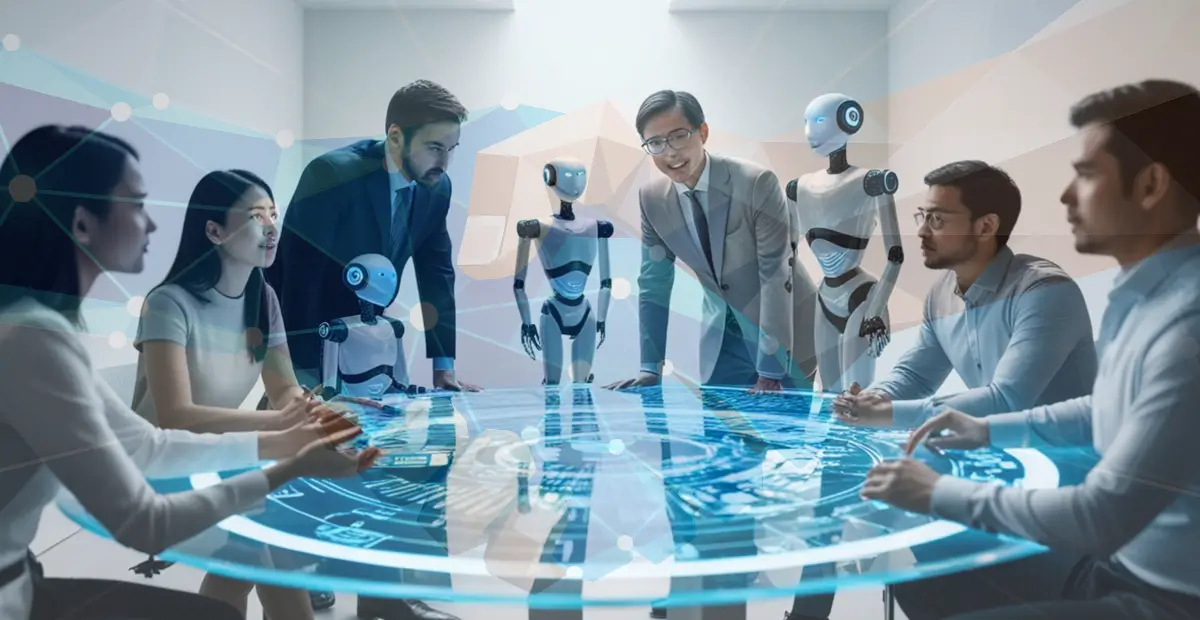
We stand at the precipice of what may be the most consequential technological revolution in human history. The emergence of artificial intelligence (AI) into our world is not merely an incremental advancement in computing power or software sophistication; it represents a fundamental reconfiguration of how we work, create, communicate, heal, govern, and understand reality itself. This unfolding story, spanning from theoretical foundations in the mid-20th century to today’s transformative applications, marks a transition point between a human-centric world and one where intelligence—in its most abstract sense—has become a new, pervasive force.The journey of AI from academic curiosity to world-altering technology has accelerated with breathtaking speed. What began as hypothetical exercises in logic and early neural network experiments has evolved into systems that can compose symphonies indistinguishable from human creations, diagnose diseases with superhuman accuracy, translate languages in real-time, and generate photorealistic images from textual descriptions. This emergence didn’t happen in isolation—it represents the convergence of unprecedented computational power, massive datasets, algorithmic breakthroughs, and global investment exceeding hundreds of billions annually.## The Historical Arc: From Turing’s Question to Today’s RealityThe conceptual foundations of AI were laid in the aftermath of World War II, when pioneers like Alan Turing began asking profound questions about machine intelligence. In his seminal 1950 paper “Computing Machinery and Intelligence,” Turing posed the simple yet revolutionary question: “Can machines think?” This inquiry shifted the philosophical discourse from abstraction to engineering challenge. The Dartmouth Conference of 1956, organized by John McCarthy, Marvin Minsky, Nathaniel Rochester, and Claude Shannon, coined the term “artificial intelligence” and established the field’s ambitious goals: to understand and recreate intelligence in computational form.For decades, AI experienced alternating periods of explosive optimism (“AI summers”) and disillusioned reduction in funding (“AI winters”). Early symbolic AI approaches, which attempted to encode human knowledge and reasoning through rules and logic, achieved impressive narrow successes but failed to deliver general intelligence. The limitations became apparent: the world is far too complex, ambiguous, and nuanced to be captured through explicit programming alone.The turning point arrived with the resurgence of connectionist approaches—neural networks inspired by biological brains. This renaissance, beginning in the 2010s, was powered by three crucial developments: the availability of massive datasets (the fuel), advances in parallel processing hardware like GPUs (the engine), and algorithmic breakthroughs in deep learning (the blueprint). Geoffrey Hinton’s 2012 ImageNet competition victory demonstrated that deep neural networks could dramatically outperform traditional computer vision techniques, igniting today’s AI explosion.## The Contemporary Landscape: AI’s Multidimensional Emergence### Transformative Capabilities Across DomainsModern AI systems have achieved capabilities that were considered science fiction just a decade ago. Large language models like GPT-4 and its successors can engage in nuanced conversation, write coherent essays across diverse subjects, generate functional computer code, and synthesize information from millions of sources. Computer vision systems now surpass human performance in specific image classification tasks, enabling applications from medical diagnostics to autonomous vehicles. Reinforcement learning has produced systems that can master complex games like Go and StarCraft II, not through brute force calculation but through strategic intuition developed from millions of simulated games.Perhaps most strikingly, generative AI has created entirely new categories of capability. Diffusion models can produce stunning visual art from textual prompts, while audio models can clone voices or create original music in specific styles. Multimodal systems integrate vision, language, and audio processing into unified architectures that begin to approximate the integrative perception of biological intelligence. These aren’t mere parlour tricks; they represent a qualitative shift in how machines interact with and interpret our world.### The Pervasive Integration into Daily LifeAI’s emergence is most evident in its seamless integration into everyday experiences. When you ask a virtual assistant for the weather, receive personalized recommendations from streaming services, have your email automatically sorted, or use real-time translation during international calls, you’re interacting with sophisticated AI systems. Social media platforms employ recommendation algorithms that shape information consumption for billions. Financial institutions use machine learning for fraud detection, risk assessment, and algorithmic trading. Transportation networks optimize routes using AI that processes real-time traffic data. Even agriculture has been transformed through AI-powered precision farming that maximizes yield while minimizing environmental impact.This pervasive integration creates what some researchers call the “invisible infrastructure” of modern life—AI systems operating continuously in the background, making decisions, filtering information, and optimizing processes with minimal human intervention. The result is an increasingly efficient world that is also increasingly dependent on systems whose internal workings are opaque to most users.## The Engine Room: What Enabled AI’s Explosive EmergenceSeveral converging factors created the conditions for AI’s rapid emergence:**Data Democratization:** The digital revolution has generated staggering amounts of data—approximately 2.5 quintillion bytes daily. This data, generated through social media interactions, IoT sensors, commercial transactions, and scientific instruments, provides the essential training material for machine learning systems. The scale matters profoundly; while early AI systems starved for quality data, contemporary models thrive on datasets of unimaginable size and diversity.**Computational Democratization:** Cloud computing has made unprecedented processing power accessible to organizations of all sizes. Where once only governments and major corporations could afford supercomputing resources, today startups and researchers can access comparable capabilities through pay-as-you-go services. Specialized AI chips, particularly GPUs and TPUs, have dramatically accelerated the training of neural networks, reducing what once took months to days or hours.**Algorithmic Innovation:** Breakthroughs in neural network architectures—particularly the transformer architecture introduced in 2017—have enabled models to process sequential data with unprecedented efficiency and accuracy. Techniques like attention mechanisms allow models to focus on relevant information while ignoring noise, mimicking (though not replicating) human cognitive processes. Transfer learning enables models trained on one task to adapt to others with minimal additional training.**Investment and Talent Concentration:** Global investment in AI has grown exponentially, with both public and private sectors recognizing its strategic importance. This has created a virtuous cycle where investment attracts talent, which produces breakthroughs, which attracts more investment. The world’s largest technology companies have made AI central to their strategies, while governments have initiated national AI strategies recognizing its economic and military significance.## The Societal Implications: Navigating the Double-Edged Sword### Economic Transformation and Labor DisruptionAI’s emergence is fundamentally restructuring labor markets and economic systems. Automation, once confined to routine physical tasks, now extends to cognitive work previously considered exclusively human domains. Legal document review, financial analysis, medical imaging interpretation, content creation, and customer service are being augmented or replaced by AI systems capable of working continuously with consistent quality.This transformation presents both profound challenges and opportunities. While AI may displace certain jobs, particularly those involving routine information processing, it simultaneously creates new categories of work and enhances human productivity in others. The critical question is whether this transition will create net employment growth or exacerbate inequality between those with skills complementary to AI and those whose roles become obsolete. Historical precedents from previous technological revolutions suggest both disruption and eventual net job creation, but the unprecedented speed of AI’s emergence may outpace society’s adaptive capacity.### Healthcare RevolutionIn medicine, AI is emerging as perhaps the most transformative technology since the discovery of antibiotics. Machine learning models can now analyze medical images with accuracy rivaling or surpassing human radiologists, detecting early-stage cancers and other conditions that might elude human perception. AI systems analyze genomic data to identify disease predispositions and recommend personalized treatments. Drug discovery, traditionally a slow and expensive process, is being accelerated through AI that can predict molecular interactions and identify promising compounds with unprecedented efficiency.Perhaps most significantly, AI enables a shift from reactive to proactive healthcare. Predictive analytics can identify populations at risk before symptoms emerge, while wearable devices with embedded AI provide continuous health monitoring. These advances promise to extend healthy lifespans and reduce healthcare costs, though they also raise important questions about data privacy, algorithmic bias in treatment recommendations, and the changing role of healthcare professionals.### Scientific AccelerationAI has emerged as a powerful collaborator in scientific discovery across disciplines. In physics, machine learning helps analyze data from particle colliders and telescopes. In biology, AI predicts protein folding with remarkable accuracy—a breakthrough that may accelerate understanding of diseases and development of treatments. In climate science, AI models process complex environmental data to improve climate predictions and identify mitigation strategies. In materials science, AI suggests novel compounds with desirable properties for everything from batteries to construction materials.This “AI for science” movement represents more than just faster computation; it offers new ways of understanding complex systems. AI can identify patterns in data that elude human researchers, propose novel hypotheses, and even design experiments. Some researchers suggest we may be entering a “fourth paradigm” of scientific discovery, where data-driven AI complements traditional theoretical, experimental, and computational approaches.### The Ethical FrontierAs AI emerges more deeply into human affairs, it raises profound ethical questions that societies are only beginning to address:**Bias and Fairness:** AI systems trained on historical data often perpetuate and amplify existing societal biases. Facial recognition systems have demonstrated racial and gender bias, hiring algorithms have discriminated against certain demographics, and credit scoring models have reinforced existing inequalities. Addressing these issues requires both technical solutions (better datasets, fairness-aware algorithms) and governance frameworks that ensure accountability.**Transparency and Explainability:** Many powerful AI systems, particularly deep learning models, operate as “black boxes” with decision-making processes that are difficult to interpret even for their creators. This opacity becomes problematic when these systems make high-stakes decisions affecting human lives in healthcare, criminal justice, or finance. The emerging field of explainable AI seeks to make these systems more interpretable without sacrificing performance.**Privacy in an AI-Saturated World:** AI systems often require vast amounts of personal data for training and operation. The tension between data utility and individual privacy creates challenging trade-offs. Techniques like federated learning (training models across decentralized devices without sharing raw data) and differential privacy (adding mathematical noise to protect individuals) offer partial solutions, but fundamental questions about data ownership and consent remain unresolved.**Autonomy and Control:** As AI systems become more capable, questions arise about appropriate levels of human oversight. In domains like autonomous vehicles, medical diagnosis, or military applications, determining where human judgment should intervene becomes increasingly complex. The emerging field of AI alignment seeks to ensure that AI systems act in accordance with human values and intentions, particularly as they approach or exceed human capabilities in specific domains.## The Geopolitical Dimension: AI as the New Frontier of PowerAI’s emergence has become a central arena for geopolitical competition. Nations recognize that leadership in AI confers economic, military, and strategic advantages. The United States and China have emerged as dominant forces, with distinct approaches reflecting their different political systems and values.The U.S. approach has been predominantly driven by private sector innovation, with major technology companies investing heavily in AI research and applications. This has fostered remarkable innovation but sometimes at the expense of coordinated national strategy. China, in contrast, has implemented a comprehensive national AI strategy with ambitious goals to become the world leader in AI by 2030, supported by massive state investment and data access less constrained by privacy concerns.The European Union has positioned itself as a regulatory leader with its proposed AI Act, establishing risk-based regulations that could become global standards. Other nations, from Canada to Singapore to Israel, have developed specialized AI strategies capitalizing on their particular strengths. This global competition accelerates progress but also creates fragmentation in standards and raises concerns about an AI arms race, particularly in autonomous weapons systems.## Looking Forward: Pathways and Possibilities### Toward Artificial General Intelligence (AGI)Current AI systems, however impressive, remain narrow in scope—excelling at specific tasks but lacking the generalized understanding and adaptability of human intelligence. The quest for Artificial General Intelligence (AGI)—systems with human-like cognitive flexibility—represents the next frontier. While timelines vary widely among experts (from decades to never), progress continues on multiple fronts: developing systems that can learn from fewer examples, transfer knowledge across domains, reason abstractly, and understand context.The emergence of AGI would represent a watershed moment in human history, with implications both exhilarating and sobering. Such systems could accelerate solutions to humanity’s greatest challenges—climate change, disease, poverty—but would also raise existential questions about human purpose, economic systems, and even what it means to be intelligent.### The Symbiosis Scenario: Human-AI CollaborationRather than viewing AI as replacement, many researchers emphasize the potential for human-AI collaboration. In this paradigm, AI amplifies human capabilities rather than replacing them—the “centaur” model where human and machine intelligence combine to achieve superior outcomes. We see early examples in chess (where human-AI teams can outperform either alone), scientific discovery, and creative arts. This symbiotic relationship may define the most productive applications of AI, leveraging both human qualities (creativity, empathy, ethical reasoning) and machine strengths (processing speed, pattern recognition at scale, consistency).### Navigating Risks: From Job Displacement to Existential ConcernsAs AI capabilities advance, concerns extend beyond immediate economic impacts to longer-term existential risks. Prominent thinkers have raised concerns about loss of human control over increasingly autonomous systems, unintended consequences of complex AI behaviors, and the potential for concentration of power. These concerns have given rise to the field of AI safety—research dedicated to ensuring that advanced AI systems remain aligned with human values and under meaningful human control.More immediately, societies must address economic transitions through education reform, social safety nets, and perhaps new economic models like universal basic income. Political systems must adapt to govern technologies that evolve faster than legislative processes. Legal frameworks must evolve to address questions of liability, intellectual property, and rights in an AI-augmented world.## Conclusion: The Unfolding RelationshipThe emergence of AI in our world represents not an event but an ongoing process—a great unfolding of capabilities whose ultimate trajectory remains uncertain. What began as specialized tools for specific tasks is evolving into a general-purpose technology with applications across every human domain. This technology reflects back to us profound questions about intelligence, consciousness, creativity, and what makes us uniquely human.As AI continues to emerge, our greatest challenge may be ensuring that its development aligns with human flourishing—not merely economic efficiency or technological capability. This will require unprecedented collaboration across disciplines: technologists working with ethicists, economists with psychologists, policymakers with researchers. It will demand that we reimagine education to cultivate distinctly human capabilities that complement rather than compete with AI. It will require governance frameworks that balance innovation with safeguards, competition with cooperation.The story of AI’s emergence is ultimately the story of our own human journey—our relentless drive to understand, create, and extend our capabilities. As we stand at this inflection point, we have the opportunity to shape this technology in ways that amplify our best qualities: our empathy, our creativity, our capacity for wisdom and ethical reflection. The choices we make in the coming years will determine whether AI becomes merely another tool, a transformative partner, or something beyond our current imagining. The great unfolding continues, and humanity holds the pen—for now.
The AI emrgence and future updates